

The short answer
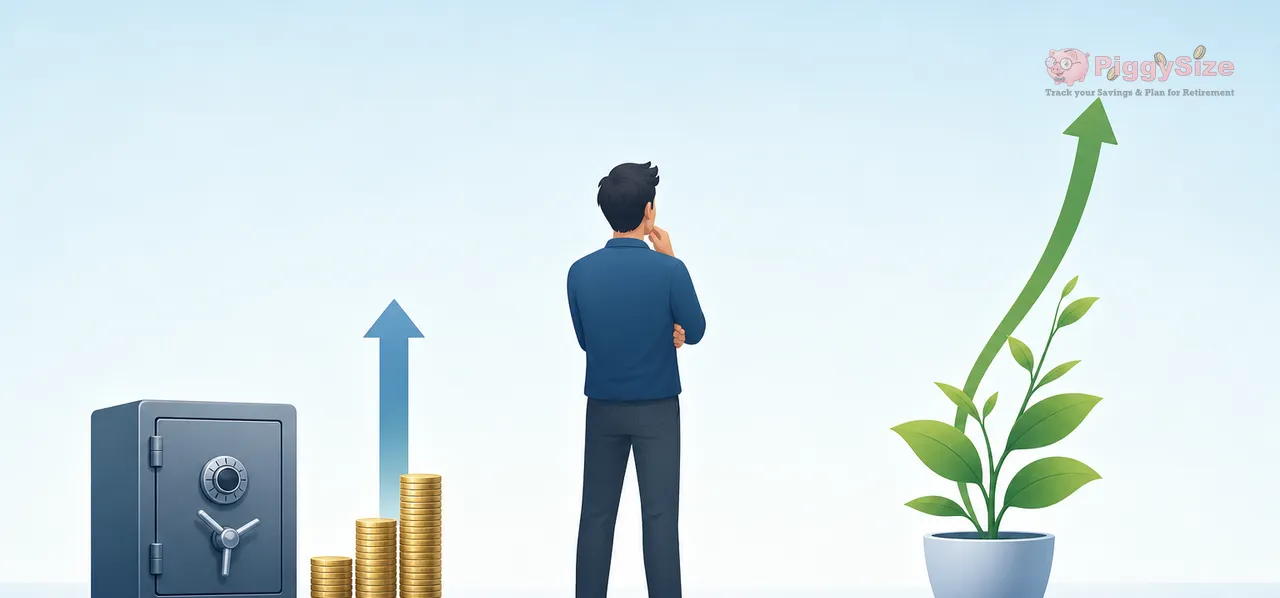
This isn't really a "which is better" question — it's a time horizon and risk question. Money you'll need within the next couple of years, or money that simply cannot lose value, belongs in something like a high-yield savings account (HYSA). Money you won't touch for many years can typically absorb the ups and downs of investing in exchange for higher long-term growth potential.
- Time horizon is the main decision driver: shorter timeframe → savings; longer timeframe → investing is more commonly considered.
- A HYSA offers stability and easy access; investing offers higher long-term growth potential with real risk of loss, especially short-term.
- FDIC/NCUA insurance protects savings account balances up to $250,000 per depositor, per institution — investments carry no such guarantee.
- Most guidance suggests fully funding an emergency cushion first, then directing longer-horizon money toward investing.
- The two aren't mutually exclusive — most households reasonably use both, split by purpose.
The core difference
| High-yield savings | Investing (stocks, funds, etc.) | |
|---|---|---|
| Primary purpose | Preserve value, stay liquid | Grow value over time |
| Risk of loss | Effectively none (insured, up to limits) | Real — value can drop, including sharply, especially short-term |
| Typical returns | Modest, tracks broader interest-rate environment | Historically higher over long periods, but not guaranteed and highly variable year to year |
| Access to cash | Immediate or near-immediate | Can require selling and settlement time; short-term losses may be "locked in" if sold at a bad time |
| Best matched to | Emergency fund, near-term goals (1–2 years) | Long-term goals (retirement, 5+ years out) |
| Insured? | Yes, FDIC (banks) or NCUA (credit unions), up to $250,000 per depositor, per institution | No deposit insurance; SIPC covers brokerage failure, not market losses |
Why time horizon does most of the work
The core tension: investments have historically grown more over long periods, but they can also lose meaningful value in the short term with no guarantee of when they'll recover. A savings account can't lose principal to a market swing, but its modest return typically won't outpace long-run inflation, meaning it's not designed to build long-term wealth on its own.
- Money needed within about 1–2 years — a house down payment, an upcoming known expense, an emergency fund — is generally kept out of the market. A downturn right before you need the cash can't be "waited out."
- Money not needed for 5+ years — retirement contributions, a long-term goal — has more time to recover from a downturn, which is why it's more commonly directed toward investing in mainstream guidance.
- The 2–5 year range is genuinely a gray zone. Some people keep it all in savings/CDs for certainty; others invest more conservatively. There's no single right answer — it depends on how much uncertainty you can tolerate.
Key point
Ask "when do I need this money, and can I afford for it to be worth less than I put in on that date?" If the answer is "soon" or "no," it points toward savings. If it's "years from now" and "yes, I can wait it out," it points toward investing.
The emergency-fund-vs-long-term split
Most common guidance frames this as sequencing, not an either/or choice:
- Build (or maintain) an emergency fund first — commonly 3–6 months of essential expenses, in a HYSA or similar liquid account.
- Then direct additional savings toward longer-horizon goals, which may include investing, once the near-term safety net exists.
- Keep near-term goals (a car, a wedding, a down payment within 1–2 years) in savings, separate from the long-term bucket.
Tends to stay in savings
- Emergency fund
- A purchase planned within ~1–2 years
- Money you cannot afford to see drop in value
Commonly considered for investing
- Retirement contributions
- Goals 5+ years out
- Money you could leave untouched through a downturn
Nuance and exceptions
- Interest rate environments shift. HYSA yields move with broader interest rates and are not fixed for the long term — a rate that looks attractive today may not in a few years.
- Inflation affects both, just differently. Savings balances keep their dollar amount but can lose purchasing power if rates fall below inflation; investments can outpace inflation over long periods but with year-to-year volatility.
- Risk tolerance is personal, not just mathematical. Two people with the same time horizon can reasonably make different choices based on how they'd react to seeing an account balance drop.
- CDs sit in between for some near-term money — a fixed rate for a fixed term, useful when the timeline for needing the cash is fairly certain, with an early-withdrawal penalty as the trade-off for locking in the rate.
- Taxes differ. Interest in a regular savings account is generally taxable income each year; investment accounts have their own tax treatment (and retirement accounts often have specific tax advantages) — details depend on account type.
Mistakes to avoid
Watch out
A common and costly mistake is investing money that's actually needed soon — then having to sell during a downturn to cover an expense, turning a paper loss into a real one.
- Leaving a large cash cushion sitting for years with no plan, missing out on long-term growth potential for genuinely long-horizon money.
- Investing the emergency fund "because savings account rates are low," then discovering the timing mismatch during an actual emergency.
- Ignoring the interest rate environment — comparing an old memory of savings rates to current investing return expectations, when both change over time.
- Treating this as all-or-nothing. Most households aren't choosing one exclusively; they're allocating different pools of money to each based on purpose.
A worked example
Consider a hypothetical household with $500/month available to save or invest, after an emergency fund is already fully built.
- Near-term goal: Saving for a car in 18 months → directs money to a HYSA
- Long-term goal: Retirement contributions on a 25+ year horizon → directs money toward investing (e.g., a retirement account)
- Split: $200/month to the HYSA for the car, $300/month toward long-term investing
This is a hypothetical illustration to show the sequencing logic, not a recommendation for any specific split.
FAQ
Is a high-yield savings account better than investing?
Neither is universally "better" — a HYSA suits money needed soon and money that must not lose value, while investing suits money with a long time horizon that can ride out market swings.
Can I lose money in a high-yield savings account?
At an FDIC-insured bank or NCUA-insured credit union, deposits are insured up to $250,000 per depositor, per institution, so the balance itself is not at market risk. Inflation can still erode purchasing power over time.
How much emergency fund should stay in savings before I invest extra money?
A commonly cited approach is fully funding an emergency cushion (often 3–6 months of essential expenses) in savings before directing additional money toward investing.
What time horizon usually favors investing over a savings account?
Many financial educators point to roughly 5+ years as a common threshold, since that gives more time to recover from a market downturn, though there is no guarantee over any specific period.
Related reading

How big should your emergency fund be?
The standard rule is 3–6 months of essential expenses, but the right number depends on how stable your income and job actually are.

How much should you have in savings by age?
By-age savings benchmarks are useful reference points, not a scorecard — the more important number is how much of your income you are saving right now.

How much should you have saved for retirement by age?
Widely cited benchmarks suggest saving roughly 1x your salary by 30, 3x by 40, 6x by 50, and 10x by 67 — but the number that actually matters most is your savings rate, not a single checkpoint.
PiggySize is a planning tool, not a financial advisor. This article is educational — projections and examples are estimates, not financial, tax, or investment advice.