

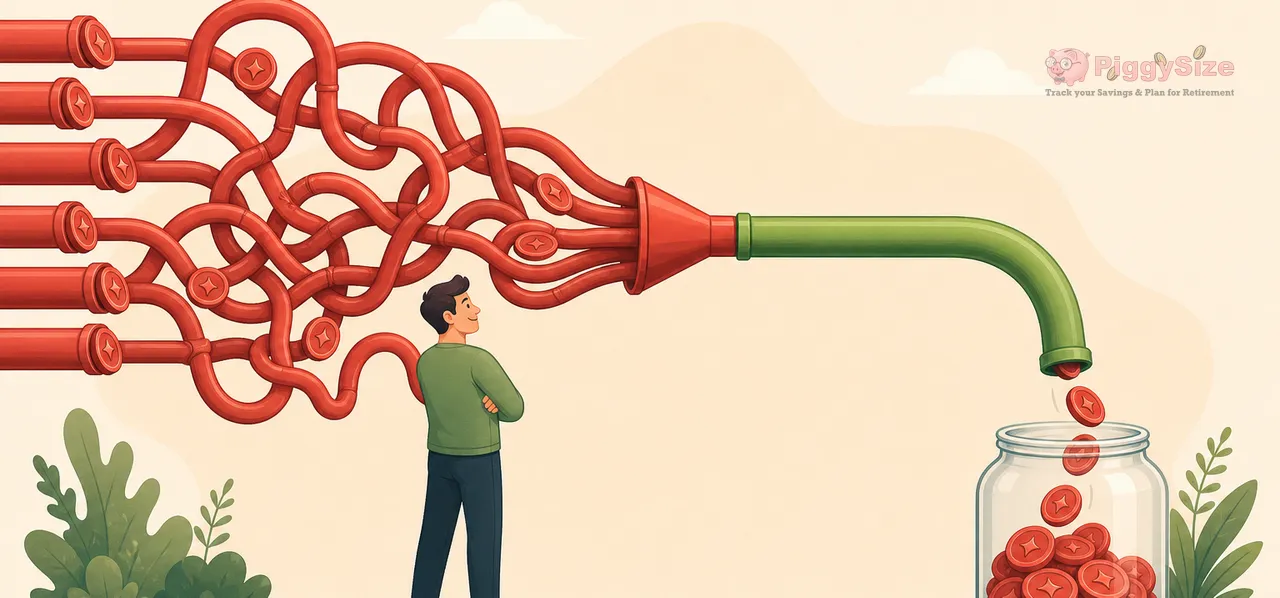
Debt consolidation means combining multiple debts into a single new loan or credit line — ideally at a lower interest rate — so you make one payment instead of several. It can genuinely lower your interest cost and simplify your finances, but it only works if the new rate is actually lower and you don't run the old balances back up afterward.
- Consolidation replaces several debts with one, usually through a personal loan, a balance transfer card, or a home equity line of credit (HELOC).
- It only saves money if the new rate is genuinely lower than the blended rate of what you're replacing, after accounting for any fees.
- It simplifies cash flow — one due date, one payment — which reduces the chance of a missed payment.
- It can backfire if old credit cards get used again after their balances move to zero, leaving you with both the new loan and fresh card debt.
- The right option depends on your credit, whether you own a home, and how much discipline you have around not reopening the debts you just consolidated.
The three common ways to consolidate
Personal loans
- A fixed-rate, fixed-term installment loan used to pay off other debts (often credit cards) in full.
- You then owe one lender, one fixed monthly payment, over a set number of months or years.
- Rate depends heavily on credit profile — strong credit can unlock rates well below typical card APRs; weaker credit may not see much improvement.
Balance transfer cards
- Move existing card balances onto a new card, often with a promotional low or 0% rate for a limited time.
- Usually charges a balance transfer fee, commonly a percentage of the amount moved, paid upfront.
- Works best when the balance can be paid off (or mostly paid off) before the promotional period ends — after that, the rate typically reverts to a standard, often high, rate.
Home equity lines of credit (HELOC) or home equity loans
- Uses your home as collateral, which can unlock a lower rate than unsecured options, since the lender has recourse if you don't pay.
- Comes with real risk: failure to repay can put your home at risk, unlike unsecured debt.
- Often has a variable rate (for a HELOC specifically), which can rise over time.
| Method | Typical rate profile | Collateral | Best fit |
|---|---|---|---|
| Personal loan | Fixed, credit-dependent | None (unsecured) | Good-to-strong credit, wants a fixed payoff date |
| Balance transfer | Promotional low/0%, then standard | None (unsecured) | Can realistically pay off balance within the promo window |
| HELOC / home equity loan | Often lower, sometimes variable | Your home | Homeowners with equity, comfortable with using the home as collateral |
Key point
Every consolidation option trades one form of debt for another. The value comes entirely from a lower rate, a simpler structure, or both — not from the debt disappearing.
When consolidation genuinely helps
- The new rate is clearly lower than the blended average rate of what you're replacing, even after fees.
- You have several different due dates and minimums to track, and consolidating into one payment reduces the odds of a missed payment.
- You have a plan to avoid re-using the old credit lines once their balances hit zero.
- Your credit is strong enough to qualify for a meaningfully better rate than your current debts carry.
- You want a fixed, predictable end date rather than open-ended revolving debt.
When it can backfire
- You keep spending on the old cards after their balances are cleared, ending up with both the new consolidation loan and fresh card debt — often the single biggest way consolidation fails.
- The new rate isn't actually lower, once fees, a shorter promotional window, or a weaker credit profile are factored in.
- You stretch the term to lower the monthly payment, which can increase total interest paid even at a lower rate, since you're paying that rate for longer.
- You use a HELOC or home equity loan for consolidation and then struggle to keep up with payments, putting your home at risk over what started as unsecured debt.
- You consolidate without addressing the underlying spending pattern that created the debt in the first place — the balance can simply rebuild.
Watch out
A lower monthly payment isn't the same as a better deal. Extending a debt's term can shrink the monthly bill while quietly increasing the total interest paid over the life of the loan. Always compare total cost, not just the monthly number.
Nuance people miss
- Consolidation doesn't reduce what you owe — it restructures it. The total balance (plus any fees) generally stays the same or slightly increases at the moment of consolidation; the benefit shows up over time through a lower rate.
- Credit score effects cut both ways. A new account and credit inquiry can cause a small, temporary dip, but paying down revolving balances (which lowers your credit utilization) and building a clean payment history on the new loan often helps over time.
- Consolidation loans and debt management plans are different. A management plan, usually run through a nonprofit credit counseling agency, negotiates directly with your existing creditors and often requires closing the accounts involved — it's not a new loan you take out yourself.
- Not all debt should be consolidated. Low-rate debt (some student loans, certain auto loans) may already carry a lower rate than any consolidation option available to you, in which case combining it with higher-rate debt could raise its effective cost.
- Origination fees matter. Some personal loans charge an upfront fee deducted from the loan proceeds — factor this into the true rate comparison, not just the advertised interest rate.
A worked example
Suppose you have three cards totaling $12,000: one at 24% APR, one at 21% APR, and one at 19% APR, with a blended weighted-average rate around 21–22%. You qualify for a personal loan at a fixed 12% rate over four years, with no origination fee.
Consolidating replaces all three variable, revolving balances with one fixed 12% installment loan — roughly half the blended rate — which meaningfully lowers the interest cost over the loan's term and gives a firm payoff date, all else equal. The plan only delivers that benefit, though, if the three original cards are then either closed or simply left unused; if $4,000 in new charges creeps back onto them over the next year, you'd be carrying the full $12,000 consolidation loan plus $4,000 in fresh card debt — a worse position than before consolidating.
FAQ
Does debt consolidation hurt my credit score?
There's often a small, temporary dip from the credit inquiry and a new account, but consolidation can help your score over time by lowering credit utilization and creating a consistent payment history, as long as old accounts aren't run back up.
Is debt consolidation the same as debt settlement?
No. Consolidation combines debts you still fully owe into one loan, usually at a lower rate. Settlement negotiates paying less than the full balance, which typically damages credit more and can have tax consequences on the forgiven amount.
Can I consolidate debt with bad credit?
It's harder — lower credit scores typically qualify for higher rates or smaller loan amounts, which can shrink or eliminate the benefit. Secured options like a HELOC may be more accessible but carry the added risk of using your home as collateral.
How much can debt consolidation actually save me?
It depends entirely on the rate difference between your old debts and the new one, any fees involved, and whether you avoid running the old balances back up. There's no fixed savings amount — it's math specific to your situation.
What happens to my old credit cards after a balance transfer?
The old cards' balances move to zero, but the accounts themselves typically stay open unless you close them. Many people keep them open to preserve available credit and account history, while avoiding new charges on them.
Related reading

Debt avalanche vs snowball: which pays off debt faster?
The avalanche method saves the most money by targeting high-interest debt first; the snowball method builds momentum by clearing small balances first. Here's the real math behind both.
How to get out of credit card debt
Stop new charges from piling up, understand exactly what you owe, then pick a payoff method and a way to lower the interest rate working against you. Here's the full playbook.

Should you pay off debt or save first?
The short answer: build a small starter emergency fund first, then compare your debt's interest rate to what savings or investing could realistically earn. Here's the order most planners suggest.
PiggySize is a planning tool, not a financial advisor. This article is educational — projections and examples are estimates, not financial, tax, or investment advice.