
You control how you sign in from Settings. Update your name and email on the General tab, and manage your password, connected sign-in accounts, two-factor authentication, passkeys, and sign-in history from the Security tab. SSO means logging in with another account, like Google or Apple, instead of an email and password. PiggySize supports email and password, Google and Apple sign-in, and passkeys.
Change your name, email, or password
- Go to Settings (opens in a new tab) and find the Your Information card.
- Edit Name, Email, or Date of Birth, then choose Save Changes.
- If you change your email, you'll see Email verification required upon save. After saving, open the verification link sent to the new address to finish the switch.
- To change your password, go to Settings → the Security tab, open the Change Password card, enter a New Password (at least 7 characters), confirm it, and choose Update Password.
Connect or remove Google and Apple
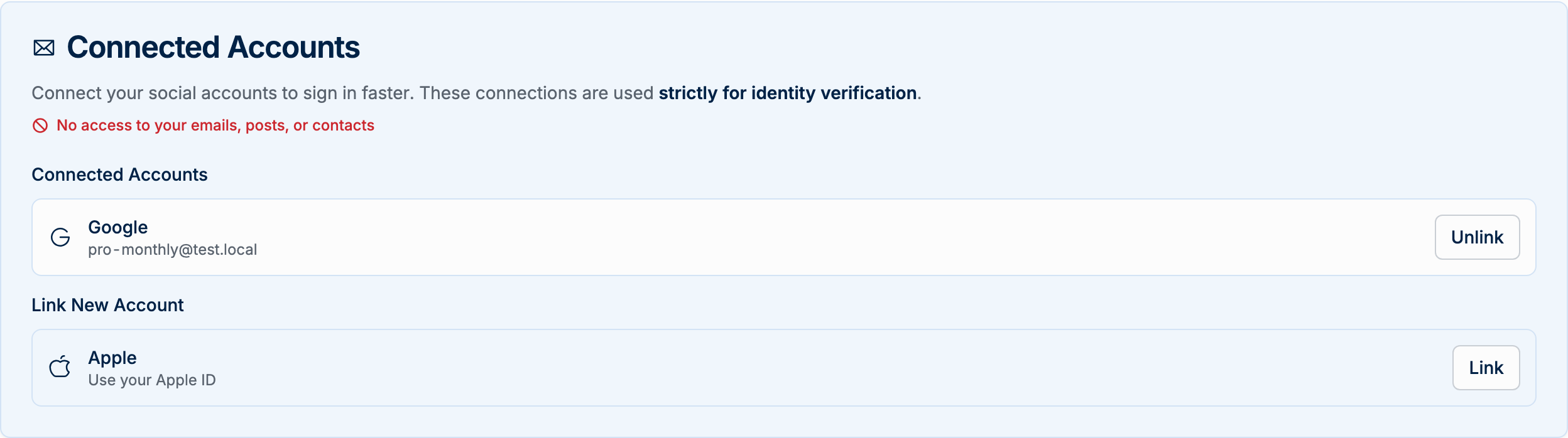
- In Settings, open the Security tab and find the Connected Accounts card.
- Under Link New Account, choose Link next to Google or Apple and follow the prompts to connect it.
- To remove one, choose Unlink next to the account under Connected Accounts.
Turn on two-factor authentication
Two-factor authentication (2FA) asks for a one-time code from an authenticator app every time you sign in, in addition to your password. It's available to every user on every plan.
- Go to Settings (opens in a new tab) and open the Security tab.
- On the Two-Factor Authentication card, choose Enable Two-Factor Authentication.
- Scan the QR code with an authenticator app (Google Authenticator, 1Password, Authy, or similar). Can't scan it? Choose Copy to enter the secret key manually instead.
- Enter the 6-digit code from your app and choose Verify & Enable.
- Save the 10 backup codes shown next — choose Copy all or Download .txt, store them somewhere safe, then choose I've saved my codes — Done. Each code works once, if you ever lose access to your authenticator app.
To turn two-factor authentication off, choose Remove on the Two-Factor Authentication card and confirm.
Get new backup codes
Once two-factor authentication is on, a Backup Codes card shows how many unused codes you have left. Choose Generate Codes (or Regenerate Codes if you already have some) and confirm. Regenerating immediately invalidates any older codes, so save the new set before closing the dialog.
Sign in with a passkey
A passkey lets you sign in without typing a password, using Touch ID, Windows Hello, or a security key built into or plugged into your device. Add a passkey once from Settings → the Security tab, then use it to sign in from then on. A passkey works side by side with your password — adding one doesn't remove your password as a sign-in option.
Add a passkey
- Go to Settings (opens in a new tab) and open the Security tab.
- On the Passkeys card, enter a name for the passkey (for example "MacBook" or "YubiKey") under Name this passkey.
- Choose Add Passkey and follow your device's prompt — Touch ID, Windows Hello, or your security key.
Sign in with a passkey
On the login page, choose Sign in with a passkey below the password form, then confirm with Touch ID, Windows Hello, or your security key. You don't need to type your email or password. Because a passkey already proves it's you and that you have the device, signing in with one skips the two-factor code prompt, even if two-factor authentication is turned on.
Rename or remove a passkey
On the Passkeys card, choose the pencil icon next to a passkey to rename it, or choose Remove to delete it. Removing a passkey means you can no longer use it to sign in — use your password or another passkey instead.
Review your recent sign-in activity
The Login History card in the Security tab shows your 10 most recent sign-ins, most recent first — each with the approximate date, location (city, region, and country, when available), device, and sign-in method (password, Google, Apple, or authenticator app). If you signed in with a passkey and have more than one, the entry also shows which one you used (e.g. "Passkey — MacBook Touch ID"), based on the name it had at the time you signed in — later renaming or removing that passkey doesn't change past entries. Sign-ins that used two-factor authentication show an MFA (multi-factor authentication) badge, and a failed attempt shows a Failed badge. If you have more than 10, choose Show all to see up to your last 50 sign-ins.
Good to know
- You always keep one way in. You can't unlink your last sign-in method. If you signed up with Google or Apple and want to remove it, first set a password. The Unlink button stays off until a password exists, and it explains this when you hover over it.
- Set a password after a social signup. If you joined with Google or Apple, the Set Password card lets you add email-and-password login so you have a backup way in.
- GitHub sign-in isn't offered right now. The supported options are email and password, Google, and Apple.
- Two-factor sign-in adds a step. Once it's on, signing in also asks for your 6-digit authenticator code, or a backup code if you don't have your device with you — unless you sign in with a passkey, which skips this step.
- Your browser or device needs to support passkeys. If it doesn't, the Passkeys card lets you know when you try to add one.
- Forgot your password? Use the reset link on the login page instead of the Settings page.
FAQ
How do I change my password?
On the Security tab in Settings, use Change Password, enter a new password of at least 7 characters, confirm it, and choose Update Password.
Why do I have to verify my email again?
A new email must be confirmed so only you can use it. After you save, check the new address for a verification link and open it.
What is SSO?
Single sign-on (SSO) lets you log in with another account, like Google or Apple, instead of typing an email and password.
Why can't I unlink my last account?
You always need one way to sign in. Set a password first, then you can unlink your last connected account.
Which sign-in options are supported?
Email and password, plus Google and Apple single sign-on.
How do I turn on two-factor authentication?
Go to Settings, open the Security tab, and choose Enable Two-Factor Authentication on the Two-Factor Authentication card. Scan the QR code with an authenticator app, then enter the 6-digit code to confirm.
What if I lose access to my authenticator app?
Sign in with one of your backup codes instead. Each code works once — generate a new set anytime from the Backup Codes card in Settings → the Security tab.
What does the Login History card show?
Your recent sign-ins, each with the approximate date, location, device, and sign-in method. Passkey sign-ins also show which passkey you used, when known, based on its name at the time you signed in.
What is a passkey?
A passkey lets you sign in with Touch ID, Windows Hello, or a security key instead of typing a password. It's tied to your device and can't be reused on another site.
Do I still need a password if I add a passkey?
No. A passkey works side by side with your password, so you can keep using either one to sign in.
Does signing in with a passkey skip two-factor authentication?
Yes. A passkey already proves it's you and that you have the device, so a passkey sign-in skips the two-factor code prompt.